Professional assessment and balanced reporting

Behavioural Risk Assessment

Behavioural Risk Assessment

Behavioural Risk Assessment

Behavioural risk assessment is the process of evaluating the likelihood, context and potential severity of future behavioural incidents. Rather than relying solely on the bite itself, a comprehensive assessment considers the biological, behavioural and environmental factors that contributed to the event and the likelihood of recurrence.

Behavioural risk assessment is the process of evaluating the likelihood, context and potential severity of future behavioural incidents. Rather than relying solely on the bite itself, a comprehensive assessment considers the biological, behavioural and environmental factors that contributed to the event and the likelihood of recurrence.

Behavioural risk assessment is the process of evaluating the likelihood, context and potential severity of future behavioural incidents. Rather than relying solely on the bite itself, a comprehensive assessment considers the biological, behavioural and environmental factors that contributed to the event and the likelihood of recurrence.

Risk is formed by systems, not labels.

Risk is formed by systems, not labels.

Risk is formed by systems, not labels.

The assessment looks at how biology, welfare, learning, environment, handling, human factors and context interact. Each can increase risk, reduce risk, or change what support is realistic.

The assessment looks at how biology, welfare, learning, environment, handling, human factors and context interact. Each can increase risk, reduce risk, or change what support is realistic.

What a comprehensive assessment considers

What a comprehensive assessment considers

What a comprehensive assessment considers

Behavioural History

Behavioural History

Previous incidents, escalation patterns, triggers, recovery, bite inhibition and learning history.

Environmental Risk

Environmental Risk

Household composition, children or vulnerable adults, other animals, public access, garden security and walking environment.

Biological Factors

Biological Factors

Pain, medical conditions, sleep quality, hormonal influences, chronic stress and welfare indicators.

Behavioural Observation

Behavioural Observation

Body language, thresholds, recovery, frustration tolerance, handling responses and social behaviour.

Human Factors

Human Factors

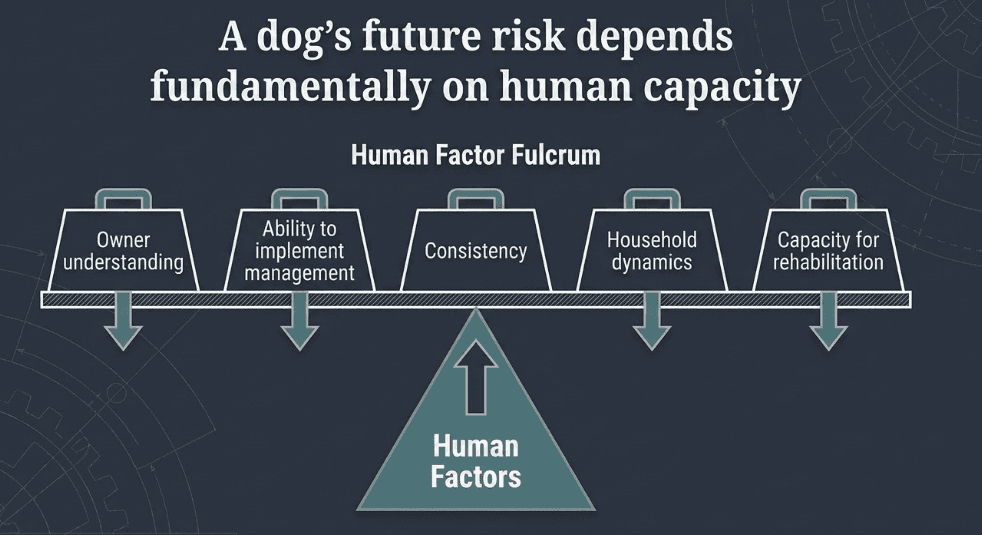
Owner understanding, ability to implement management, consistency, household dynamics and capacity for rehabilitation. A dog’s future risk depends enormously on the humans.
Evaluating the available evidence as a whole

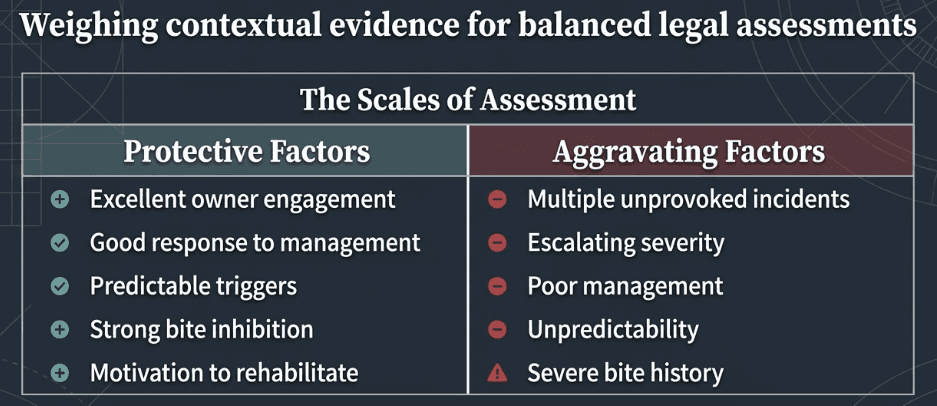
Evaluating the available evidence as a whole

Behavioural risk is not a fixed characteristic of a dog. It changes according to context, management, health, welfare and the environment in which the dog is living.


A comprehensive assessment therefore considers both current risk and the factors likely to increase or reduce that risk over time.

Behavioural risk is not a fixed characteristic of a dog. It changes according to context, management, health, welfare and the environment in which the dog is living.


A comprehensive assessment therefore considers both current risk and the factors likely to increase or reduce that risk over time.

The purpose is to understand what changes risk and what can realistically minimise it, rather than reducing the dog to a simplistic label.

The purpose is to understand what changes risk and what can realistically minimise it, rather than reducing the dog to a simplistic label.

To arrange an in-person assessment please use the contact details below.

To arrange an in-person assessment please use the contact details below.

Contact

Email: ogjess@outlook.com

24 hr 📞: +44 7505 971110

Scotland-wide